 Rufus R. Noble
 Continuing Education Activity
The need for long-lasting, secure, and efficient hair removal for aesthetic and medical reasons is growing. Many methods for hair removal are available, including epilation through waxing or plucking, removal through shaving or chemically depilatory electrolysis, eflornithine cream and lasers, and intense IPL (IPL) methods. Many IPL and laser systems are readily available, and they are the most effective option for reducing hair over the long term. This article explains the various lasers, their applications, as well as contraindications and potential complications. It also emphasizes the importance of the multidisciplinary team to educate patients considering hair removal.
Objectives:
- Define the various lasers that are used to remove hair.
- Examine the guidelines for laser hair removal.
- Discuss the pitfalls of the elimination of laser-generated hair.
- Develop strategies for interprofessional teams in better coordination and communication to help advance methods for the removal of hair using lasers and to improve the results.
Introduction
The need for safe, long-lasting, and efficient hair removal for both aesthetic and medical purposes is increasing. There are a variety of methods for removing hair readily available, including epilation through waxing or plucking, depilation with cutting, depilatories using chemical electrolysis, eflornithine cream, as well as lasers, and intensive IPL (IPL) methods. A variety of IPL systems and lasers are available and are among the most effective choices for long-term hair reduction. [1] The principle of action of these systems is that they target melanin inside the epithelium of hair, in the follicular epithelium and hair matrix, by emitting light at wavelengths that range between 600- 1200 nanometers (nm) as the wavelengths of these are taken up from melanin. [2]
Anatomy and Physiology
Selective Photothermolysis
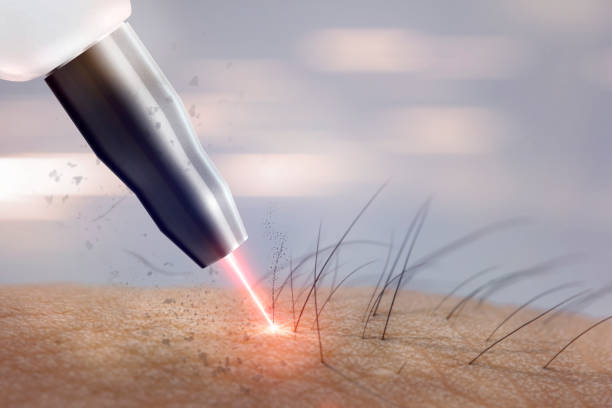
Lasers for treating skin rely according to the concept of “selective photothermolysis.” This refers to a site-specific thermally-mediated injury to tissues with microscopic size through the selective absorption of radiation by the target and chromophores. Natural or artificial chromophores absorb broadband or monochromatic electromagnetic radiation with specific wavelengths. The chromophore that is used for laser-based hair removal is melanin. Melanin absorbs light within 300 to 1200 nm. Lasers with this wavelength are well-suited to reduce hair. [3] [44
An Extended Theory of Selective Photothermolysis
The absorption of the target may not be uniform. In such cases, the parts that absorb weakly might have to be destroyed by the heat diffusion of the more absorbent components. This is called the “extended theory of selective photothermolysis.” The principle is used for laser photoablation. The amount of melanin is more significant in melanin-bearing structures such as hair shafts and the matrix cells of the hair follicle. Melanin absorbs energy from lasers and then distributes it to surrounding hair follicular structures. This causes the destruction of the hair pyramid and the hair bulge stem cells. [5]
Indications
- Hypertrichosis and Hirsutism
- Aesthetic uses
- Medical conditions like pilonidal sinus, pseudofolliculitis barbae, and acne keloidalis nuchae. [6]
Equipment
Lasers to reduce hair loss include the following:
- Ruby Laser(694 nm) Red light is transmitted via synthetic ruby crystals that are more effective for skin types and darker hair (skin types I-III*) [7]
- Alexandrite Laser(755 nm) Higher penetration is ideal for hair with lighter density (skin kinds I to III) [8]
- Diode Laser (810 nm) – Penetrates deeper, delivers better fluency, less epidermal damage, safer in darker skin (skin types I-V)[9]
- Neodymium-doped Yttrium-Aluminium-Garnet (Nd: YAG) Laser (1064 nm) – Better penetration, less epidermal damage, relatively less melanin absorption (skin types I-VI)[10]
- Intense Pulse Light (IPL) or Broadband Light (BBL) (500-1200 nm) – High-intensity pulses of polychromatic, non-coherent light are delivered by a flash-lamp; various filters allow the narrowing of the emitted wavelength band, which can be used on darker skin, larger areas can be covered due to its larger spot size, less expensive than an actual laser but not as effective[11][12][13]
* Fitzpatrick Skin Types[10]
- I- White skin with pale shades with blue/green eyes and red/blond hair; burns all the time but does not tan.
- II Fair skin, blue eyes, fair skin It burns quickly, tans poor
- III- Whiter, darker skin; tans following the initial burn
- IV- Light brown skin it burns only lightly and tans easily
- V- Skin tone brown tone; very rarely burns; dark tans easily
- VI- Dark brown or black skin; never burns, always tans darkly
Preparation
- Complete clinical history to determine if there is a problem with infection and drug intake, among other things.
- The evaluation of hormones to determine the causes of hirsutism.
- Help the patient control expectations. It is important to emphasize that the procedure is permanent hair reduction, not removal.
- Assess the types of hair and skin for the best laser and the appropriate parameters.
- Do not cause hair loss by squeezing or waxing for six weeks before the procedure.
- Sunscreens are prescribed for up to 6 weeks before the procedure, focusing on exposed areas.
- Photos taken during the procedure, subject to permission, to keep an account of the treatment’s response.
- The area should be cut before the procedure to allow some slight stubbles to form, which will be enough of a target for the laser not to absorb too much energy from the hair shaft.
- You must obtain your informed consent.
- If necessary, a topical cream could be applied for one-half up to an hour before performing the surgery. [14] [1515
Technique or Treatment
- Cleanse the area to eliminate oil from the skin
- Place the patient in a comfortable position.
- Eye protection is essential for the patient and the operator.
- Avoid reflective surfaces and metallic objects that are near the laser.
- Personalize the parameters according to the individual’s hair and skin kind and the laser employed.
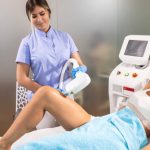
- The handpiece should be placed perpendicular to the surface. Make sure it is pressed down lightly but firmly to bring the hair follicles closer to the surface. This will temporarily reduce blood flow to the area of treatment.
- The erythema and perifollicular edema are a normal side-effect, and it should be made clear to the patient prior to operation. [14] [1515
Post-Procedure Care
- While most machines come with inbuilt cooling systems, ice packs, and cooling agents are sometimes used in the post-procedure phase to lessen swelling and pain.
- In the event of accidental epidermal damage, Topical antibiotics can be applied.
- A strict sun protection regimen using sunscreen is mandatory.
- Topical steroid creams can be prescribed to decrease erythema or swelling. [14] [1111
Hair matrix is susceptible to laser treatments during this phase in the growth cycle. Therefore, a series of treatments are necessary to treat every hair follicle that is most sensitive to treatment. In the first treatment phase for hair elimination, up to 4 sessions spread by 4 to 6 weeks is the minimum needed for achieving satisfactory results. In the future, patients may require regular maintenance treatments every 6-12 months since the hair on the vellus can grow back. [16]
A variety of factors could influence the final outcome. There are many factors that can affect the product, such as:
- Hair position (axillary as well as pubic hair ) responds more strongly than the hair at the extremities or chest)
- The color of hair and skin (light skin color) of Fitzpatrick Skin types I-IV, with dark hair, will get the most effective result due to the absence of melanin on the skin and the high concentration of melanin that can absorb laser energy into the hair’s follicles)
- Hair growing stage (anagen hair being the most delicate)
- Laser type
- Status of hormones
- The treatment plan [2Treatment plan [2
Complications
Other epidermal structures adjacent to melanin in the hair bulb may compete for absorption and could result in laser energy being absorbed by the pigment within the epidermis. This can hinder the efficacy of treatment and may cause adverse reactions caused by epithelial damage that is adjacent. [17]
Commonly, adverse reactions to lasers or IPL-based hair removal are post-treatment erythema, pain as well as burns. [18]
More serious adverse effects are blistering crusting hyperpigmentation, purpura, and even the formation of scars. [19] [2020 Ocular complications resulting from accidents can be seen. Paradoxical hypertrichosis is not often seen and is more common in the skin type III and in the presence of IPL techniques. [21] [2222 [2323
Clinical Significance
The choice of the appropriate lasers that have the correct parameters, customized for each patient, is vital, especially for those with dark skin. The majority of problems can be prevented if proper precautions are taken in altering the fluence of the spot, size, wavelength, and the application of the appropriate cooling. Therefore, it is crucial that trained and experienced personnel with extensive knowledge of the processes, methods, procedures, and difficulties implement these methods.
Enhancing Healthcare Team Outcomes
Removal of hair by laser is done by numerous healthcare professionals, including dermatologists, nurses, plastic surgeons, primary care physicians, and a variety of cosmetic surgeons. Because of the inadequate supervision, complications occur frequently when performing the procedure. In addition, patients are frequently misled about their expectations. The most important thing is to select the correct laser, specifically for those with dark skin. Commonly, adverse reactions of IPL or laser-based hair removal are post-treatment erythema, pain, and burns. [18] The more severe adverse effects are the formation of blisters, crusts, depigmentation or purpura, and occasionally the formation of scars. [19] [20[20] Ocular complications resulting from injuries from accidents can be observed. Hypertrichosis paradoxically may occur rarely but is more prevalent in the skin type III and the case of IPL devices.
Lasers can generally eliminate hair but rarely give a permanent solution for hair growth. Retouching maintenance treatments are necessary for most patients for the long term.